












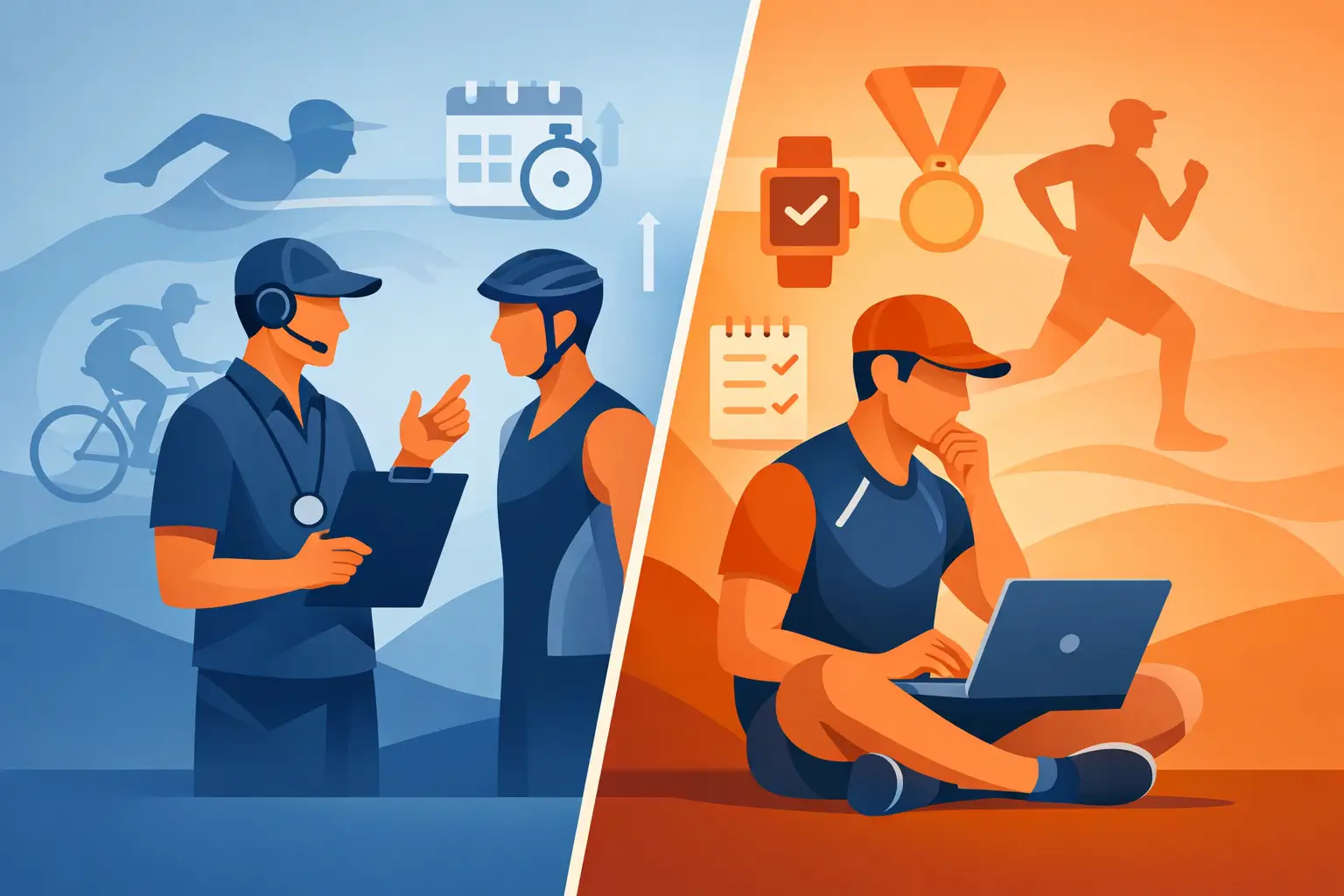
You can get surprisingly fit by training yourself. You can also spend six months working hard, arrive at your key race flat, and wonder why the numbers never moved. That is the real tension in triathlon coaching vs self coaching. It is not simply about whether you can write your own sessions. It is about whether your training decisions consistently lead to better performance.
For some athletes, self coaching works well for a period. They are motivated, reasonably informed, and disciplined enough to train without much hand-holding. For others, especially those chasing age-group improvement or balancing work, family and racing, self coaching becomes a limit. The difference usually comes down to objectivity, progression and execution.
Triathlon coaching vs self coaching: what actually changes?
The most obvious difference is structure. A coach does not just hand over a weekly plan. Good coaching connects the full training cycle - current ability, event demands, life stress, recovery profile and race goals - into one system. That means each session has a purpose, and each training block builds toward a clear outcome.
Self coached athletes often do a decent job with individual sessions. They can find plenty of workouts online, build a basic program, and train consistently for a while. The problem is not access to information. The problem is knowing what to do less of, what to repeat, when to progress, and when to back off. Endurance athletes are rarely short on effort. They are more often short on precision.
That precision matters in triathlon because three disciplines magnify every programming mistake. Swim volume can leave you too tired to run well. Hard bike work can quietly undermine run durability. Added life stress can turn a productive week into accumulated fatigue. Coaching is valuable because it manages these interactions before they become performance problems.
Where self coaching works well
Self coaching is not automatically the wrong choice. In the right situation, it can be effective.
If you are new to triathlon, targeting completion rather than competition, and happy to learn through experience, self coaching can be enough. The early gains in endurance sport are often driven by simple consistency. You do not need a highly detailed performance system to improve from a low base. You need regular training, sensible load, and enough patience to build fitness gradually.
It can also suit experienced athletes who know their body well, understand training principles, and have a stable schedule. If you can accurately assess fatigue, set realistic paces, and avoid the temptation to turn every key session into a test, you may be able to coach yourself effectively for a time.
Cost is another real factor. Coaching is an investment, and not every athlete is ready for that. A self coached approach can be a practical stage in your development, especially if you are still deciding how seriously you want to pursue the sport.
But this is where honesty matters. Many athletes say they are self coached when they are really self directed and reactive. They train hard when motivation is high, miss sessions when life gets busy, and patch together plans based on what feels productive that week. That is not coaching. It is improvising.
Where self coaching usually falls short
The first issue is bias. Most athletes are poor judges of their own training needs. Some are too conservative and never create enough load to improve meaningfully. Others are too aggressive and stack intensity until niggles, illness or burnout force a reset.
The second issue is misreading feedback. A tough session can feel effective while being poorly timed. A low heart rate can look like fitness when it is actually fatigue. A strong long ride can create confidence while masking weak run durability. Training data helps, but data without interpretation can mislead just as easily as it can guide.
Then there is the accountability piece. Left alone, athletes tend to drift towards what they enjoy and avoid what exposes weakness. That might mean plenty of riding, inconsistent swimming, or running volume that never quite reaches the level needed for race performance. A coach keeps the program honest.
This is one of the biggest advantages in triathlon coaching vs self coaching. The coach is not emotionally attached to your favourite session, your preferred discipline, or your usual excuses. They make decisions based on performance, not comfort.
What good triathlon coaching provides
At a serious level, coaching is not just program delivery. It is performance management.
A good coach assesses where time can actually be gained. Sometimes that means lifting threshold on the bike. Sometimes it means improving swim efficiency so you stop paying an early energy tax. Sometimes it means reducing training, not adding more, because your current load is already beyond what you can absorb.
That outside view is valuable because progress in triathlon is rarely linear. You may need to hold back in one discipline to move forward in another. You may need to fix fuelling, sleep or pacing before another hard block makes sense. You may need race-specific work that reflects your event, your course and your current limitations rather than a generic internet plan.
Coaching also creates accountability around execution. It is one thing to know your easy runs should be easy. It is another to actually run them that way when ego wants a faster pace on the watch. It is one thing to understand that recovery week matters. It is another to accept it when motivation says push on. That discipline is where many athletes make their biggest gains.
For athletes with ambitious goals, this is the real value. You are not buying motivation. You are buying clarity, progression and standards.
Triathlon coaching vs self coaching on cost and return
The usual argument for self coaching is that it is cheaper. On paper, that is true. In practice, the calculation is broader.
Poorly structured training has a cost. Repeated injury interruptions have a cost. Turning up underprepared for a major race has a cost. Spending years at the same level because your training never addresses the real limiter has a cost as well.
That does not mean every athlete needs one-to-one coaching immediately. But if you are already spending money on race entries, kit, travel, nutrition and equipment, it is worth asking what actually drives performance. A better bike matters less than a better training process.
The return on coaching is strongest when your goals are specific. If you want to qualify, set a personal best, step up in distance, or finally train consistently around a demanding life schedule, coaching often saves time and wasted effort. For a busy athlete, that matters as much as fitness.
Which athletes benefit most from a coach?
Athletes moving from participation to performance usually benefit quickly. The same is true for those stuck at a plateau, repeatedly injured, or inconsistent despite strong motivation. If you have races that matter to you and want your training to match that intent, coaching becomes more relevant.
It is also a strong fit for athletes with limited time. When training hours are capped, every session has to count. Random volume is less useful than targeted work delivered well. A coach helps make those trade-offs.
Gene Convery Endurance Academy sits squarely in that performance-focused space - athletes who want structure, measurable progression and a training approach built around outcomes rather than guesswork.
How to decide honestly
Ask yourself a few direct questions. Are you improving year on year, or just staying busy? Do you know why each phase of your training is structured the way it is? Can you separate ego from evidence when setting paces and volume? Are you consistently healthy and race-ready, or often carrying fatigue and doubt?
If the answers are strong, self coaching may still serve you. If they are vague, you are probably relying more on effort than direction.
The best choice is not the one that sounds tougher or more independent. It is the one that gives you the highest likelihood of consistent, durable progress. For some athletes, that will be self coaching for now. For many, especially those with clear performance goals, coaching removes the noise and gives training the standard it needs.
Serious endurance improvement rarely comes from doing more. It comes from doing the right work, at the right time, for long enough to let it compound.