






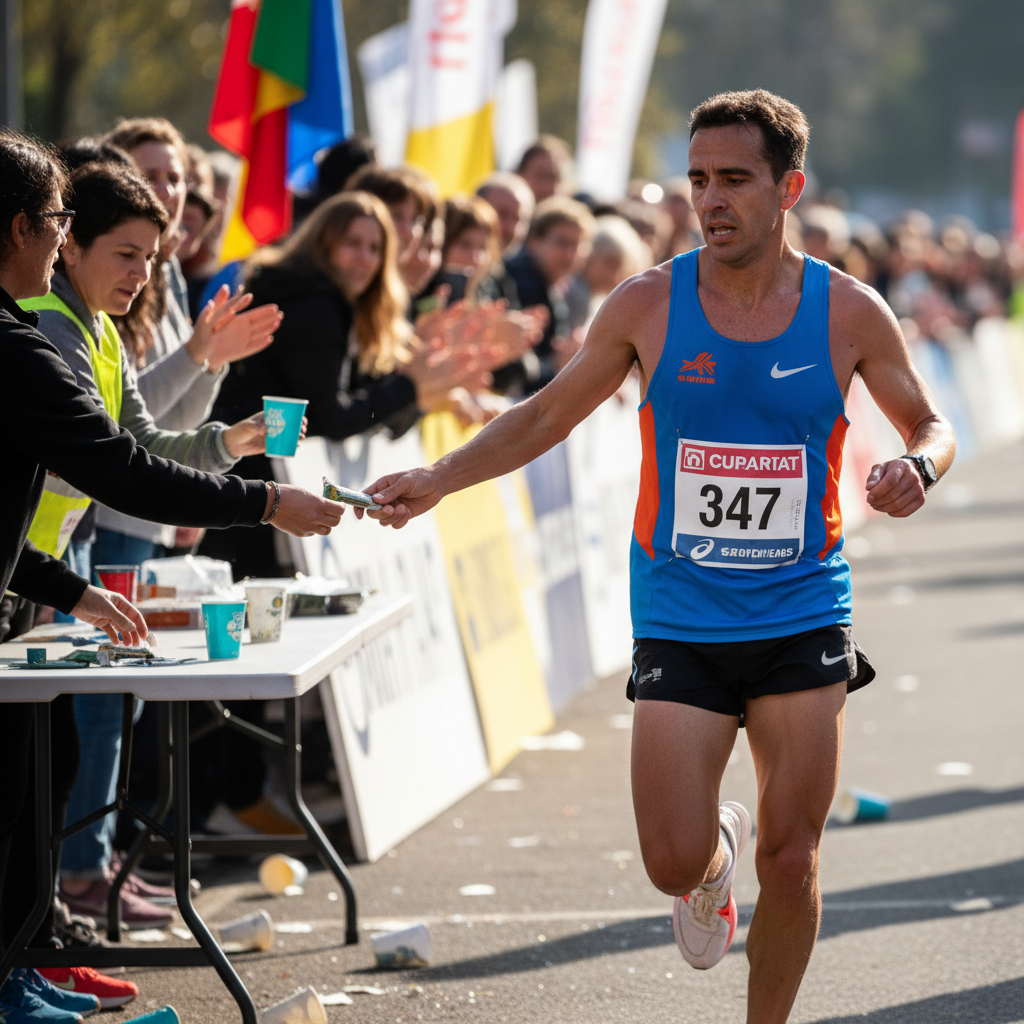






A runner can have a strong aerobic engine and still give away minutes by leaking energy with every stride. To improve running economy is to reduce the oxygen and energy required to hold a given pace. It is one of the reasons two athletes with similar VO2 max results can race very differently.
For the serious age-group runner or triathlete, economy is not about finding a magical cue or copying an elite athlete’s gait. It is built through a training system that improves force production, movement tolerance, technical consistency and the ability to use those qualities when fatigue arrives.
What running economy actually measures
Running economy is commonly assessed as the oxygen cost of running at a steady submaximal speed. Put simply, the more economically you run, the less effort a set pace demands. That can leave more capacity for the final kilometres of a half marathon, a stronger run leg off the bike, or a faster closing lap in a 5 km.
Economy sits alongside aerobic capacity, lactate threshold and durability. It does not replace them. An athlete who becomes more economical but lacks the aerobic conditioning to sustain race pace will still be limited. Equally, an athlete who only chases volume without building strength or speed may become very fit at running inefficiently.
It also changes with pace. Your mechanics at easy pace are not identical to your mechanics at 10 km pace. Training needs to prepare you for the speeds that matter in your event, not just accumulate comfortable kilometres.
Improve running economy by getting stronger
Strength training gives runners a larger force reserve. When each foot strike requires a smaller percentage of your available strength, the stride is generally easier to control and less costly to repeat. This is particularly relevant late in races, on hills and after the bike leg in triathlon.
The priority is not bodybuilding fatigue. It is developing usable strength through well-executed compound movements and progressive loading. Squats, split squats, deadlifts, calf raises and step-ups can all have a place, chosen according to the athlete’s training history, movement capacity and event demands.
Calf and soleus strength deserve particular attention. These tissues manage high forces every time you run and contribute to the spring-like action of the ankle. A runner with poor calf capacity often loses stiffness and rhythm as the session progresses, even if their cardiovascular fitness is sound.
Two strength sessions per week work well for many athletes during a general preparation phase. Closer to key races, one focused maintenance session may be enough. The trade-off is recovery: a heavy lower-body session placed before a critical track workout can compromise the quality of the running that matters most. Organise the week so strength supports your key sessions rather than competes with them.
Use faster running with a clear purpose
Easy mileage builds the platform, but economy also responds to exposure to faster, controlled running. Strides are one of the most effective and lowest-cost tools available. After an easy run, complete four to eight relaxed accelerations of roughly 15 to 25 seconds, building to a quick but controlled pace. Walk or jog fully between efforts.
Strides reinforce coordination at speed without turning a recovery run into a hard workout. They are especially valuable for marathoners and triathletes whose programmes can otherwise become dominated by steady aerobic work.
Hill sprints can serve a similar purpose. Short efforts of eight to 12 seconds up a moderate gradient encourage forceful, compact mechanics with less overstriding than flat sprinting. Keep the recovery long and stop before form deteriorates. This is neural and mechanical work, not a lactate session.
For more developed runners, intervals at 3 km to 10 km pace can improve the ability to hold economical mechanics at race-relevant speed. The correct dose depends on your event and current load. A runner preparing for a marathon might use modest doses alongside threshold work, while a 5 km specialist can tolerate a more prominent speed component.
Technique: change only what needs changing
Most runners do not need a complete technique overhaul. Forcing a prescribed foot strike, arm carriage or cadence can create tension and move stress to another area. The better question is whether a visible technical issue is costing energy or increasing injury risk.
Look for simple, repeatable qualities: tall posture through the torso, a stable pelvis, feet landing close to the body, relaxed shoulders and arms that move purposefully rather than across the body. These are observations, not rigid positions. Individual structure, mobility and preferred rhythm matter.
Cadence is often discussed as though there is one ideal number. There is not. A slight increase in step rate can help an athlete who consistently overstrides or brakes heavily, but chasing 180 steps per minute regardless of pace or body size is poor coaching. Use video, session feel and pace consistency to guide decisions.
The best technical work is usually done when fresh. Add drills, strides or brief hill sprints before fatigue changes your movement. Then allow normal running to reinforce the pattern. Conscious cues should be brief and specific. If you need to think about six body parts during a tempo run, the cue is not serving you.
Build durability before chasing marginal gains
Economy that only appears in the first 30 minutes is not race economy. The ability to maintain form when glycogen is lower, temperatures rise and the legs are carrying fatigue is a product of progressive endurance training.
Long runs, aerobic volume and controlled tempo work create that durability. They also need to be appropriate to the athlete. A busy professional with a history of calf issues may improve more from consistent four-run weeks than from adding a fifth run that repeatedly causes breakdown. Consistency is a performance tool, not a conservative fallback.
For triathletes, the run must be viewed in the context of cycling load. A high-volume bike week can leave the legs unable to absorb quality running, even where the run plan looks sensible in isolation. Brick sessions can be useful for practising rhythm off the bike, but they should not replace fresh running sessions that develop speed and mechanics.
Fuel and recover for quality movement
Low energy availability is not a badge of endurance discipline. Poor fuelling reduces training quality, slows recovery and makes it harder to preserve coordination under load. If a key session regularly feels flat, the answer may not be another technique drill. It may be carbohydrate intake, inadequate sleep or excessive accumulated fatigue.
For sessions lasting longer than an hour or those performed at quality, plan fuelling deliberately. For long races, practise your race nutrition during long runs so your gut and pacing strategy develop alongside fitness. Hydration matters too, particularly through Australian summer conditions, where heat can raise cardiovascular strain and make a normal pace feel unexpectedly expensive.
Recovery is where the adaptation becomes usable. Easy days need to be easy enough to absorb the harder work. Sleep, sensible load progression and early management of niggles protect the continuity required for economy to improve over months, not merely one session.
Track the signs that your economy is improving
Laboratory testing can provide useful data, but it is not essential. In training, look for practical markers: a familiar aerobic route at a faster pace for the same heart rate, a lower perceived effort at steady pace, or the ability to finish a tempo session with better form and control.
Compare like with like. The same route, similar weather, similar fatigue and similar fuelling provide better information than isolated watch data. Do not overreact to one run in wind, heat or poor sleep. Trends across several weeks are what matter.
At Gene Convery Endurance Academy, this is the standard worth applying: assess the athlete, identify the limiter, then place the right work into a programme that can be sustained. Running economy improves when strength, speed, endurance and recovery are trained as connected qualities rather than separate boxes.
The next time you review a training week, do not ask only whether it contains enough kilometres. Ask whether it gives you the capacity to produce force, practise efficient speed and arrive at the next key session ready to do it well. That is where faster running begins.